Building a Nonprofit Tech Stack That Scales With Your Mission
This article is based on my conversation featured in Double the Donation’s “The Nonprofit Boost” podcast, November 2025.
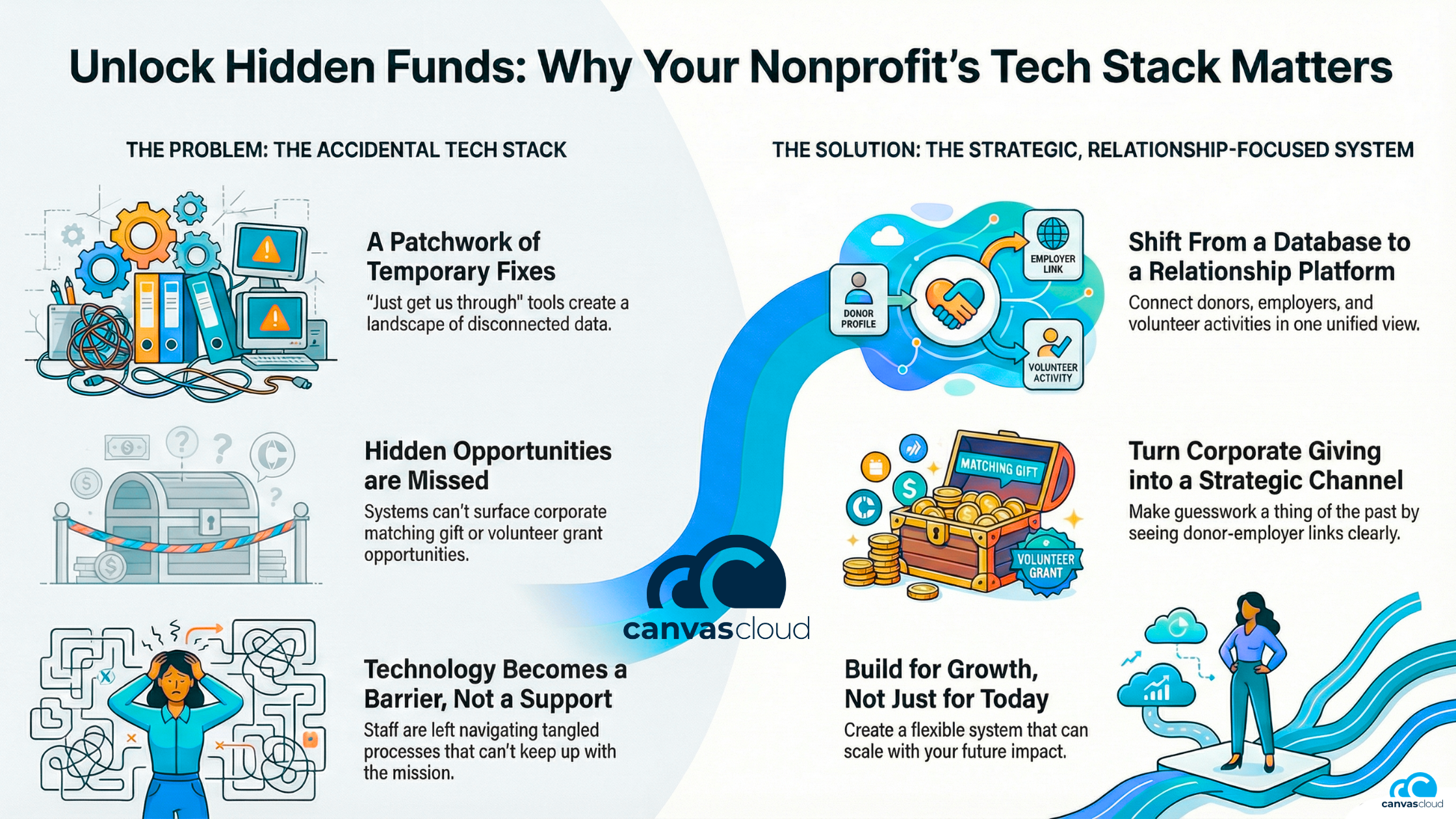
Your tech stack didn’t become complex overnight. It happened through a series of practical decisions made under pressure: a “just get us through this event” tool here, a temporary volunteer spreadsheet there, a free donation form that seemed good enough at the time. Each choice solved a real need. Yet over months and years, these small fixes accumulated into a landscape of tools, processes, and disconnected data that never quite gave your teams what they needed to see clearly or operate confidently.
This familiar tension – between immediate needs and long-term infrastructure – was the starting point of my recent conversation with Amelia Baumann on The Nonprofit Boost, the podcast from Double the Donation. The episode, “Leveraging Corporate Support for Fundraising Success,” explores how nonprofits can build the systems and data foundations necessary to unlock corporate giving, reduce hidden opportunity costs, and ultimately do more of the work that matters.
Watch the episode below or keep reading and I’ll expand on some of the themes we discussed.
Why My Work Became Rooted in Nonprofits
My path into nonprofit consulting didn’t start with strategy frameworks or Salesforce certifications; it started during a conversation with my son when he was about eight years old. As we talked, I realized that the future I hoped he would grow into wasn’t going to emerge on its own. If I wanted to contribute to a world that cared more, listened more, and supported communities more effectively, I had to align my own work with those values.
At the time, I was consulting with mid-market and enterprise clients, helping them optimize processes and technology. Impact, in that context, often meant efficiency and profitability. But when I began working with human services nonprofits, I noticed something fundamentally different. When technology gave them time back, it wasn’t used to tighten margins or increase revenue; it was used to serve more families, support more children, and deepen their mission work.
Technology became something more than workflow or automation, it became a multiplier of human impact. Every record in the system represented a real person. Every workflow affected someone’s experience. Every data point had a story behind it. That realization changed the direction of my career and in 2019 I co-founded Canvas Cloud, a Gold/Crest Partner of Salesforce, serving both as a Systems Integrator (SI) and as a Managed Services Provider (MSP).
Where Technology Goes Wrong: Not Through Malice, But Momentum
Most nonprofit leaders can point to a moment where their tech stack stopped feeling like a support and started feeling like a barrier. But it’s rarely because someone chose the wrong system; it’s because organizations often respond to immediate needs without the space to think about what will sustain them in the long term.
One of the most common patterns I see is the accumulation of “temporary” solutions. A free platform seems harmless (maybe even ideal) when budgets are tight. But free tools almost never come with the flexibility to grow with the organization. They solve one moment in time while quietly creating fractures that become apparent only as the nonprofit evolves. Eventually, staff are left navigating tangled processes, disconnected data, and systems that can’t keep up with what the mission now requires.
The opposite pattern is just as challenging: the attempt to fix everything at once. After years of patching, tweaking, and improvising, organizations understandably want a clean slate: a chance to replace everything with something new. But replatforming at that scale, without a phased roadmap, can be overwhelming. Staff lose confidence. Change fatigue sets in. New systems start to feel just as confusing as the ones they replaced.
In both cases, the solution is not more technology, it’s more intention. Technology should start with clarity, not complexity. Begin with what works. Understand what doesn’t. And build gradually toward a cohesive system that supports your mission, your staff, and your future, not just your present.
Corporate Giving Is a Major Opportunity, If Your Systems Can Support It
A big focus of our Nonprofit Boost conversation was workplace giving and corporate support. These programs – matching gifts, volunteer grants, payroll giving, in-kind sponsorships – represent some of the most scalable and underutilized opportunities for nonprofits.
But very often, organizations miss out not because they don’t have donors who qualify, but because their systems can’t surface the right information. Employment fields go unfilled. Matching gift eligibility is unknown. Volunteer engagement is tracked separately from donor engagement. Corporate contacts never make it into the CRM. And as a result, nonprofits operate without visibility into opportunities that already exist.
Workplace giving is not just a fundraising strategy; it’s a data strategy. It requires systems that can show relationships clearly: donor ↔ employer, employer ↔ programs, donor ↔ volunteerism. Without that relational structure, corporate support becomes guesswork rather than a strategic revenue channel.
The Foundation of Good Technology: Relationships, Not Records
One of the most important shifts nonprofits can make is rethinking their systems not as databases, but as relationship management platforms. A CRM should help you understand:
Who your donors are
Where they work
Which corporate programs exist
Who the champions are within each company
How volunteerism intersects with giving
How engagement changes over time
When this information lives in one place – or at least flows into one place – you gain a single, reliable view of your ecosystem. Tools like Double the Donation strengthen this by cross-referencing donor data with known corporate programs, identifying matching opportunities, and making it easier for nonprofits to steward both individuals and their employers.
From there, the work becomes about communication, stewardship, and clarity, all of which depend on clean, connected data.
Metrics That Tell the Real Story
While total dollars raised is the easiest metric to track, it’s rarely the most insightful. Revenue tells you what happened. Relationship-based metrics tell you why it happened and whether it will continue.
In my experience, nonprofits should pay close attention to how donors deepen their engagement. Are matching gift donors giving again next year? Are they signing up for volunteer opportunities? Are companies increasing participation, sponsoring events, or organizing volunteer days?
Engagement trends paint a much clearer picture of the health and sustainability of your fundraising strategy than revenue alone. And they reveal whether your systems are supporting meaningful, long-term connection or simply processing transactions.
Making Technology Upgrades Feel Possible
Change doesn’t have to be overwhelming. In fact, the best technology improvements often start small: a clear understanding of your current systems, a thoughtful plan for where you need to be, and a phased roadmap that respects staff capacity.
The goal is not to replace everything. The goal is to build technology that your mission can grow into: technology that scales with you, instead of requiring a rebuild every time you hit a new milestone.
And if you don’t have internal capacity to define that roadmap, that’s where external partners can help. A good consulting partner should help you think two steps ahead, anticipate future needs, and design systems you won’t outgrow.
Why Volunteer and In-Kind Programs Deserve System Support Too
Volunteerism and in-kind contributions are often where community impact becomes tangible, yet these programs are frequently tracked in ways that separate them from your broader relationship data. That disconnect makes it harder to see which companies are deeply invested in your mission, how individuals engage across multiple channels, and where opportunities may be emerging.
When volunteer and in-kind data is fully integrated into your CRM, you gain a clearer understanding of your community and a more powerful story to tell donors, partners, and grantmakers.
Preparing for Growth Before It Arrives
In the podcast, Amelia asked a question I love: “If a nonprofit received a $10 million gift, what should they do first from a technology perspective?”
Most organizations won’t receive a gift of that size, but the question still matters. It forces us to consider whether our systems are built for the scale of impact we’re striving toward, not just the scale we’re managing today.
Being “technology ready” isn’t about predicting the future. It’s about building systems and processes that are flexible enough to support it.
Where Canvas Cloud Comes In
At Canvas Cloud, we help nonprofits move from scattered tools to connected systems. Systems that support stronger fundraising, clearer reporting, healthier data, and better stewardship.
Whether you’re strengthening your workplace giving strategy, modernizing your Salesforce environment (moving from NPSP to Agentforce Nonprofit), or simply trying to move beyond the cycle of temporary fixes, we’re here to help you turn technology into an advantage rather than an obstacle.
Interested in evaluating your technology or corporate giving readiness? We offer a free Salesforce Health Check Assessment and I’ll meet with you afterwards to review it, no strings attached. Sign up here.